

Will Bay Area Insurance Companies Drop You for Having a Federal Pacific or Zinsco Panel?
This article is general information for California homeowners. It is not legal, insurance, or code advice. Always confirm requirements with your insurance company, local building department, and a licensed electrician.
You just opened a letter from your insurance company. They're giving you 60–90 days to replace your electrical panel or they'll drop your coverage. If your home has a Federal Pacific, Zinsco, or Sylvania panel, here's what that letter means and what you need to do.
Yes. Many California insurers are increasingly denying coverage or choosing not to renew policies for homes with Federal Pacific Electric (FPE), Zinsco, and certain Sylvania electrical panels. These panels have documented safety concerns and higher failure rates, which increase fire risk.
If you get a non-renewal or "fix this or we'll drop coverage" letter, you usually have 60–90 days to replace the panel and provide proof. In Santa Clara County, panel replacement typically costs between $1,800 and $16,000 depending on whether it's a subpanel or main service, your home's size, and how complex the upgrade is.
If You Just Got an Insurance Letter, Do This First
Check these items before you panic:
- Read the letter carefully and circle the deadline date for non-renewal.
- Highlight exactly what they're asking for: "panel replacement," "upgrade to current standards," or "electrical inspection."
- Look at your panel door and note the brand: Federal Pacific, FPE, Stab-Lok, Zinsco, Magnetrip, Sylvania, GTE‑Sylvania, Challenger, or anything else listed.
- Take clear photos of the panel door (with branding) and the inside with the breakers showing.
- Make a quick list: city you live in (San Jose, Campbell, Sunnyvale, Morgan Hill, etc.), approximate age of the home, and whether you've had any past electrical work done.
- Call your agent and ask: "Will a full panel replacement with permit and final inspection clear this, and what exactly do you need as proof?"
If the letter mentions Federal Pacific, Zinsco, or Sylvania by name, plan on a full panel replacement, not a quick repair.
Why Insurers Are Moving Away From Federal Pacific, Zinsco, and Sylvania Panels
Federal Pacific Electric (FPE) panels were installed in millions of homes between about 1950 and 1980. In many older Campbell, Willow Glen, and Los Altos homes, they're still sitting there untouched. Independent testing and field experience have shown:
- FPE breakers can fail to trip during overloads in a significant percentage of tests.
- The "Stab-Lok" breaker design and bus bar connection can loosen or lose reliable contact over time.
- A breaker that doesn't trip when it should lets wires overheat, and overheated wires start fires.
Zinsco panels (also sold as Magnetrip, and later under GTE‑Sylvania and some Challenger/Sylvania branding) show a different set of problems that we still see in older homes in Sunnyvale, Mountain View, and parts of Palo Alto:
- Breakers can fuse to the bus bar when they overheat.
- Once fused, the breaker may look "off" but still be feeding power.
- Aluminum bus bars and connections corrode, increasing resistance and heat.
Certain Sylvania panels share similar bus/breaker connection issues and are now being grouped in the same risk category by many insurers.
From an insurance company's standpoint, these are known high-risk products. If there's a fire and the report says "originated at a Federal Pacific panel," that's an expensive claim and a potential liability. So more carriers are simply choosing not to insure homes that still have them.
What Insurance Letters Usually Say
The wording varies, but homeowners around Santa Clara, San Jose, and Los Gatos commonly see something like:
"Our inspection identified a Federal Pacific/Zinsco/Sylvania electrical panel at the property. Due to documented safety concerns with these panels, we are unable to continue coverage unless the panel is replaced with a modern, code-compliant panel within 60–90 days. Please provide proof of replacement including permit, inspection approval, and photos."
Or:
"Coverage will not renew unless the electrical panel is upgraded to meet current safety standards."
A few companies offer a liability acknowledgment form instead of immediate replacement. On paper it looks like an easy out: "Sign this and we'll keep you covered." In reality:
- The form mainly protects the insurer, not you.
- If there's a fire tied back to that panel, they may deny the claim.
- When you sell the home, that document becomes one more thing to disclose to buyers and their insurers.
Before you sign anything, at least call your agent and ask what it actually changes for future claims.
"Can't I Just Switch Insurance Companies?"
Sometimes. But the window is closing.
Here's what we see in practice across San Jose, Saratoga, and Morgan Hill:
Many standard carriers (the big national names) either:
- Refuse to write new policies on homes with FPE/Zinsco/Sylvania panels, or
- Require replacement as a condition of binding coverage, or
- Let existing customers renew once or twice, then eventually require a change.
Non-standard or "surplus lines" carriers will sometimes write policies, but:
- Premiums can run 40–60% higher than standard coverage.
- Deductibles and exclusions can be stricter.
- They may still set a future deadline for panel replacement.
Over five years, that extra premium can get close to the cost of a straightforward panel upgrade in a typical Campbell or Santa Clara home. And you may still end up replacing the panel anyway when underwriting tightens again.
When You Should Stop and Call a Licensed Electrician
You should get a professional assessment if:
- You received a non-renewal or "we will not continue coverage" letter mentioning your electrical panel.
- Your insurer asked for panel photos or an "electric inspection" during renewal, refinance, or a new purchase.
- Your inspection report on a home in Willow Glen, Sunnyvale, Palo Alto, or Los Gatos mentions Federal Pacific, FPE, Stab-Lok, Zinsco, Sylvania, GTE‑Sylvania, or Challenger.
- The panel cover is hot to the touch, discolored, or smells like burnt plastic.
- Breakers are warm, trip frequently, or won't reset properly.
- Lights flicker across multiple rooms (especially in an older mid‑century home like an Eichler in Palo Alto or Mountain View).
- You've added big new loads (EV charger, hot tub, heat pump) to a 100A or 125A service.
Any of these are good reasons to have a licensed electrician in Santa Clara County take a look, even if your insurer hasn't said anything yet.
Do You Need a Permit for Panel Replacement?
Short answer: yes, almost always, for main panel work.
In Santa Clara County cities like San Jose, Campbell, Sunnyvale, and Los Gatos, a typical main panel replacement or service upgrade will involve:
Permit application
Your electrician submits plans showing the existing panel, new panel, amp rating (100A, 125A, 200A, etc.), main breaker size, and a basic circuit schedule.
Plan review
The city or county building department reviews and either approves or requests corrections.
- Some cities turn this around in 3–5 business days.
- Others, especially busier ones, may take 2–3 weeks or longer.
Utility scheduling
For a main service replacement, the utility must schedule a disconnect and reconnect. For PG&E customers (most of Santa Clara County), we typically see:
- Typical lead time: 2–12 weeks depending on workload and season.
- Peak construction seasons (spring/summer) are slower.
Note: Palo Alto and the City of Santa Clara have their own municipal utilities. Palo Alto customers coordinate through Palo Alto Utilities (CPAU), and Santa Clara customers work with Silicon Valley Power (SVP). Scheduling processes and timelines may differ from PG&E.
Installation day
- Power is shut off at the meter.
- The old FPE/Zinsco/Sylvania panel and associated equipment are removed.
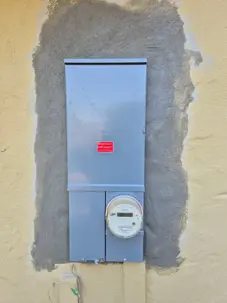
- A new combination service entrance panel (meter‑main combo, standard for California) is installed.
- Existing circuits are reconnected and labeled.
- Power is restored once the inspector or utility signs off.
- Typical power outage: 6–8 hours.
Inspections (two stages)
Day-of inspection: Often done the same day while the panel is open. Inspector checks connections, grounding, bonding, working clearances, etc.
Final inspection: 1–3 weeks later, after stucco/siding/drywall repairs around the panel are completed. Inspector confirms everything is finished, labeled correctly, and meets NEC and California Title 24 requirements.
Final approval and record
Once final inspection passes, the jurisdiction issues approval. Your insurer will want permit records and proof that the work passed.
Skipping permits is not a good idea here. Most insurance letters specifically ask for permit and inspection proof. Unpermitted panel work can cause problems when you sell, refinance, or have a claim.
How Electricians Typically Replace FPE, Zinsco, and Sylvania Panels
The details vary between a 1960s Willow Glen ranch, a 1970s Cambrian tract home, and a hillside Los Gatos property, but the broad steps are similar.
1. Assessment and Planning
A good assessment usually takes 30–45 minutes and covers:
- Brand, size, and condition of the existing panel (100A, 125A, or 200A).
- Condition of the meter/main combo and service entrance (conduit, mast, weatherhead).
- Panel location and working clearance (closets and tight corners can trigger relocations).
- Existing loads: electric range, dryer, AC, EV charger, pool, spa, etc.
- Future plans: EVs, heat pumps, solar, battery storage.
This is where the electrician decides whether you need:
- A simple like-for-like main panel swap,
- A main panel replacement plus service upgrade (often to 200A), or
- A relocation and more extensive rework.
2. Permits and Utility Coordination
For homeowners in San Jose, Sunnyvale, Campbell, and Los Gatos, this is the part you never see:
- The electrician submits the permit application and any required drawings.
- Permit fees typically run $650–$950 in most Santa Clara County cities, with Palo Alto often closer to ~$1,900.
- Once the permit is approved, the contractor submits a disconnect/reconnect or service upgrade request to the utility.
This coordination is what makes the schedule a little unpredictable. When the utility is busy, you can be staring at that insurance deadline doing calendar math.
3. Panel Installation Day
On the actual day in your driveway in Campbell or Morgan Hill:
- The utility (or a qualified party) shuts off power at the meter.
- The old FPE, Zinsco, or Sylvania panel is removed.
- A new, modern combination service entrance panel (meter‑main combo) is installed.
- Circuits are reorganized and reconnected, and new breakers (AFCI/GFCI where required) are installed.
- Everything is labeled clearly.
- The inspector does the day-of inspection while everything is still open.
- Power is turned back on.
Total outage: usually 6–8 hours.
4. Finishing Work and Final Inspection
If stucco, siding, or drywall were cut to access the panel or move it, those areas are patched and textured. In older Eichler-style homes in Sunnyvale or Palo Alto, this sometimes involves careful work around exterior panel locations.
Once the finish work looks acceptable (typically 1–3 weeks after install):
- The electrician schedules the final inspection.
- The inspector checks that everything is complete, labeled, and accessible, and signs off.
5. Documentation for Your Insurer
You'll want a clean packet to send to your insurance company:
- Permit documentation from your city or the county.
- Day-of inspection approval.
- Final inspection approval (green tag or online confirmation).
- Photos of the new panel with the door closed and open showing manufacturer, model, and labeling.
- Paid invoice from your licensed electrician.
That bundle is usually enough for carriers to reinstate or continue coverage. Some may send their own inspector for a quick visit.
Typical Panel Replacement Costs in Santa Clara County (2026)
These are ballpark ranges we see across Santa Clara, Milpitas, and Gilroy. Your exact quote will depend on your house and scope.
Subpanel replacement: $1,800–$3,500
- Replacing a subpanel that feeds a garage, addition, or specific area.
- Same location, similar size, no major rewiring.
- Does not include main service upgrades.
Typical main panel replacement: $4,500–$9,000
Most common in older homes in Campbell, Willow Glen, and north San Jose:
- Replacing the main FPE/Zinsco/Sylvania panel with a new 100A, 125A, or 200A meter‑main combo.
- Includes permits, utility coordination, and both inspections.
- Does not include full-house rewiring or fixing every old junction box in the home.
Complex replacement / service upgrade: $9,000–$16,000+
More likely in hillside Los Gatos, Monte Sereno, or larger custom homes:
- Relocating the panel to a better/safer location.
- Upgrading to 225A or 400A service.
- Significant rework of feeder or branch circuits.
- Stucco/siding/drywall work and clean finish carpentry.
Separate item: Underground trenching for service upgrades commonly starts around $3,500 before any driveway, patio, or landscape restoration.
What drives the price?
- Amp upgrade: Jumping from 100A or 125A to 200A typically adds $1,150–$1,725.
- Panel relocation: Moving the panel to a new wall can add $920–$1,725 depending on distance and rerouting.
- Service entrance upgrades: New mast, weatherhead, and meter‑main can add $1,380–$2,875.
- Permit fees: City-dependent, $650–$1,900.
- Access and finishes: Stucco, siding, or tight interior closets cost more than a simple exterior swap.
There is no way to get an accurate price from photos alone. An in-person assessment is the only honest way to quote this.
What To Do Step-by-Step If You Receive a Non-Renewal Notice
Mark the hard deadline.
Find the exact non-renewal date and put it in bold on your calendar. Assume it's firm.
Call your insurer or agent and clarify.
Ask:
- "If I replace the panel with a modern, code-compliant one and provide permit + inspection proof, will that satisfy this?"
- "Do you also require any subpanels to be replaced?"
- "Exactly what documents do you want from my electrician?"
Schedule a licensed electrician for an assessment.
In most cases across San Jose, Palo Alto, and Santa Clara, a 30–45 minute visit is enough to determine:
- Current panel type, amp rating, and condition.
- Whether you need a straight swap or a service upgrade.
- How complex the relocation (if needed) will be.
- Whether your timeline is realistic given utility scheduling.
Approve a full panel replacement if required.
For Federal Pacific, Zinsco, and problem Sylvania panels, "just swapping breakers" is almost never accepted by insurers and doesn't address the root design issues. A modern, properly sized meter‑main combo with new breakers and proper grounding is the standard solution.
Confirm permits, inspections, and documentation up front.
Before you sign anything, make sure your electrician will:
- Pull the permit in your city (San Jose, Campbell, Sunnyvale, etc.) or with Santa Clara County.
- Handle utility scheduling.
- Be present for day-of and final inspections.
- Provide you copies of all permits, approvals, and photos.
Submit your documentation early.
Don't wait until the last week. Once final inspection passes, send your insurer:
- Permit record and both inspection approvals.
- Photos of the installed panel (door closed and open).
- Paid invoice from a licensed electrical contractor.
Some carriers may follow up with their own inspection, so give yourself a buffer of 1–2 weeks before the deadline.
FAQs: Insurance & FPE / Zinsco / Sylvania Panels
Which insurance companies are dropping coverage for these panels?
Underwriting rules change, but across the Bay Area we see more large carriers and regional companies tightening their guidelines around Federal Pacific, Zinsco, and certain Sylvania panels. Some refuse new policies until panels are replaced; others flag them during renewal or inspections. The only way to know your exact situation is to ask your current insurer.
Can I avoid replacing the panel if I find a flexible carrier?
Maybe temporarily. You might find a carrier willing to write or keep coverage, usually at a higher premium. But:
- You're still living with the underlying safety risk.
- A future inspection or claim may bring the issue back.
- You may end up replacing the panel later under more pressure.
How long do I usually have after getting a non-renewal notice?
Most letters we see in Santa Clara County give 60–90 days. A few are shorter. The deadline is typically non-negotiable. If you let coverage lapse, it's harder and more expensive to get a new policy, and your mortgage company will not be happy.
Will homeowners insurance pay to replace my panel?
Generally, no. Insurance usually doesn't pay to correct pre-existing conditions or outdated equipment. Think of a panel replacement like a roof replacement or plumbing upgrade: it's on the homeowner, not the carrier.
What happens if I ignore the letter and do nothing?
- Your policy will not renew.
- Your lender may place "force-placed" insurance on the home at much higher cost with worse coverage.
- Future carriers may see the lapse and be more cautious.
- You still have an older panel with known safety issues.
Can I just replace the breakers and leave the panel?
For FPE, Zinsco, and many older Sylvania setups, breaker-only swaps don't solve the main problem: bus bar design, contact reliability, and known failure patterns. Most carriers won't accept that as a fix, and many electricians will not recommend it as a long-term safety solution.
Do Federal Pacific subpanels need to be replaced too?
It depends on the insurer and how the subpanel is used. Some letters specifically call out subpanels; others don't. From a safety perspective, FPE subpanels share many of the same issues as FPE main panels. Many electricians recommend replacing them, especially if they serve garages, additions, or critical loads.
How do I know if my panel is Federal Pacific, Zinsco, or Sylvania?
- Open the panel door (don't remove the cover) and look for the brand name: "Federal Pacific Electric," "FPE," "Stab-Lok," "Zinsco," "Magnetrip," "Sylvania," "GTE‑Sylvania," "Challenger."
- FPE Stab-Lok breakers have a very distinctive narrow shape and latch.
- Zinsco breakers often have colored handles on a vertical bus.
- If you're not sure, take clear photos of the interior and labels and send them to a licensed electrician.
Will replacing my panel increase my home's value?
You may not see full dollar-for-dollar payback on an appraisal report, but it removes a major red flag. Buyers in Campbell, Palo Alto, and Sunnyvale are getting savvier about these panels, and so are their inspectors and insurers. Having a modern, code-compliant panel in place makes transactions smoother and cuts down on last-minute renegotiations.
Are there payment options for panel replacements?
Most electrical contractors have financing options through third-party providers. Some homeowners use HELOCs or personal loans. If you're up against a 60–90 day insurance deadline, talk about payment at the beginning so the project isn't delayed.
What if I'm buying a home that still has one of these panels?
Treat it as a known, real cost. Get quotes from electricians in Santa Clara County and either:
- Ask the seller to replace it before closing, or
- Negotiate a credit at closing based on actual bids.
Don't assume "we'll worry about it later." More underwriters are catching these panels earlier in the process.
Why Homeowners in Santa Clara County Call Watson's
- Experienced with Federal Pacific, Zinsco, and Sylvania panel replacements in older homes across Campbell, Willow Glen, Los Altos, and Sunnyvale.
- We handle permits, utility coordination, and both inspections from start to finish so you're not stuck in the middle chasing departments.
- Honest scoping: we'll tell you when a straightforward main panel swap is enough and when a larger service upgrade actually makes sense.
- Familiar with Santa Clara County and city-specific permit fees and inspection processes.
- Detailed documentation: permit records, inspection approvals, and clear photos packaged in a way insurers understand.
- Licensed (C‑10), insured, and familiar with the quirks of 1950s–1980s Bay Area construction.
- Gilroy-based and serving all of Santa Clara County, from Milpitas and Santa Clara down through Morgan Hill and Gilroy.
Need Help With an Insurance Letter About Your Panel?
If you're in Santa Clara County and your insurer is threatening non-renewal over a Federal Pacific, Zinsco, or Sylvania panel, Watson's can inspect the panel, explain your options, and handle the replacement, permits, and documentation your carrier is asking for.
Call or text Watson's Charging Stations & Electric at (408) 642‑6547 to schedule a panel assessment. We serve Santa Clara County.