

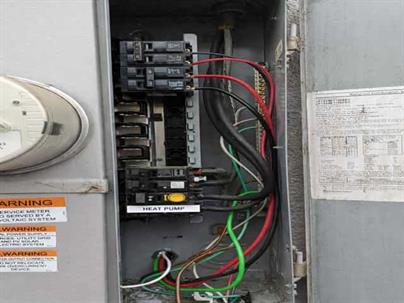
Preparing Your Panel for a Heat Pump HVAC Upgrade: What Santa Clara Homeowners Need to Know
This article is general safety information for California homeowners. It is not legal, insurance, or code advice. Always confirm requirements with your local building department, utility, rebate program, and a licensed electrician.
Most residential heat pump systems require a dedicated 30–50 amp 240‑volt circuit. If your home has a 100A or 125A panel that already feeds an EV charger, electric water heater, or other high‑load appliances, you'll often need a 200A panel upgrade before adding a heat pump. Many Santa Clara County homes built before 1990 have undersized panels that can't safely support a heat pump plus modern loads. A licensed electrician should run a load calculation before your HVAC contractor starts work to avoid mid‑project surprises and ensure code compliance.
Your 25‑year‑old gas furnace just died. The HVAC contractor recommends a heat pump – better efficiency, rebates, no more gas.
Then you hear: "You might need an electrical upgrade first."
Sometimes that's fear‑based. Sometimes it's real. Here's how to tell the difference in a Santa Clara County home.
Will Your Panel Handle a Heat Pump?
It comes down to three things.
1. Your Panel's Total Capacity
Rough rule of thumb:
- 100A or 125A panel: Often too small once you add a heat pump on top of modern loads.
- 200A panel: Usually workable, depending on what else you're running.
- 225A / 400A: Rare in tract homes; more common in larger Los Gatos, Saratoga, or Palo Alto customs.
If you have a 200A panel with spare breaker spaces and no EV / big electrification yet, you can often add a heat pump without upgrading the panel. If you're on 100A or 125A in a 1970s Campbell or Los Gatos house, odds tilt toward "you'll need more."
2. Your Current Electrical Load
Even with 200A, you can be close to the edge if you already have:
- EV charger (roughly 30–60A)
- Heat pump water heater (~4,500W, around 20A)
- Existing central AC (30–50A)
- Electric range (40–50A)
- Multiple subpanels or shop loads
Now add a heat pump at 30–50A. That's why we run a formal load calculation instead of guessing.
3. Available Breaker Slots
Heat pumps need a dedicated double‑pole breaker (usually 30–50A). If your panel is physically full, you'll need either:
- A panel upgrade with more spaces and capacity
- A properly fed subpanel (only if the main has capacity)
- Limited use of tandems (only in panels designed for them)
We see a lot of 1960s–1970s 100A panels in Campbell, Willow Glen, and Mountain View that are already jammed full just feeding updated kitchens and a few window units.
Quick Panel Check Before Your Heat Pump Install
Without opening anything:
- Look at the main breaker. It will say 100, 125, 200, or 400.
- Count open spaces. You need two adjacent open slots for a 2‑pole breaker.
- List your big loads: EV charger, electric water heater, electric range, central AC, spa, etc.
- Note panel age. If it's 25+ years old, even if it "works," it might not meet modern code/needs.
- Check the brand. Federal Pacific, FPE, Stab‑Lok, Zinsco, Magnetrip, Sylvania, and some Challenger panels should be replaced on principle, not upgraded around.
Give that info to a licensed electrician. If anything looks borderline, have them run a load calculation before the HVAC crew shows up.
When to Call an Electrician Before HVAC Work
Get an electrical assessment first if:
- Your main panel is 100A or 125A
- Your panel is full with no open breaker slots
- You already have an EV charger or heat pump water heater
- Your home was built before 1990
- You've added major loads in the last 5 years (kitchen, spa, shop, etc.)
- Your HVAC contractor says you "might" need an upgrade but isn't sure
- Your panel is Federal Pacific, FPE, Stab-Lok, Zinsco, Sylvania, Magnetrip, or Challenger
- Breakers trip across multiple circuits when big loads run
Sorting this out up front is cheaper than having the HVAC crew on site, system half‑installed, and then everyone discovers the panel can't handle it.
Why Heat Pumps Use More Power Than Gas Furnaces
Gas furnaces:
- Use gas for heat
- Use electricity for the blower and controls (usually < 1,000W)
Heat pumps:
- Use electricity to move heat – all‑electric heating and cooling
- Typical residential systems draw 30–50A at 240V while running
That's roughly like running:
- An electric dryer and
- A large window AC
…at the same time, for hours.
Now drop that into a Sunnyvale or Palo Alto home that also has:
- A 40–50A EV charger
- A 20A heat pump water heater
- A fully electric kitchen
You see why panels become the bottleneck.
How Much Does a Panel Upgrade Cost (For Heat Pump Readiness)?
If you need more panel, here's the realistic picture in Santa Clara County.
Typical 100A / 125A → 200A Upgrade – $4,500–$9,000
Includes:
- New 200A combination service entrance panel (meter‑main combo)
- Service entrance conductor upgrades as needed
- Grounding and bonding updates
- Permits and inspections
- PG&E disconnect/reconnect coordination
Does not include:
- Rewiring old branch circuits throughout the home
- Fixing every legacy wiring issue in the house
Key cost drivers:
- Amp upgrade: 100A/125A → 200A usually adds $1,150–$1,725
- Panel relocation: If code/location requires moving it, add $920–$1,725
- Service entrance upgrades: New mast/conduit/combos often add $1,380–$2,875
- Permit fees:
- Most Santa Clara County cities: $650–$950
- Palo Alto: commonly around $1,900
Timeline:
- PG&E scheduling: 2–12 weeks
- Permitting: 1–6 weeks depending on city (San Jose, Campbell, Sunnyvale, Los Gatos, etc.)
- Install day: 6–8 hours without power
- Inspections: Day‑of + final inspection 1–3 weeks later after stucco/siding repairs
If you know you're going heat pump + EV (or other electrification), bundling the panel upgrade with your HVAC project lets you take the pain once: one permit stack, one PG&E coordination, one outage.
What About Load Management Devices?
Some installers pitch "smart" load management instead of upgrading the panel.
What they do:
- Monitor major loads (EV, heat pump, etc.)
- Temporarily throttle or pause one when the other spikes
- Keep total draw under a set limit (often close to 200A)
When they can work:
- You already have a 200A panel that's close but not technically overloaded
- You're adding one or two high‑draw loads (EV + heat pump)
- You're okay with them "sharing" capacity, not all running at max at once
When they don't solve it:
- You have a 100A or 125A panel and are fundamentally short on total amperage
- Your existing loads already push the panel hard without the heat pump
- The utility or inspector won't accept it as a replacement for proper capacity
We occasionally use load management in San Jose or Mountain View when a 200A panel is borderline and the homeowner wants to avoid going to 400A. For most 100A/125A homes, it's a band‑aid on an undersized system.
Do You Need a Permit?
Yes.
For a heat pump install you typically need:
- Mechanical/HVAC permit – usually handled by your HVAC contractor
- Electrical permit – for the new circuit and/or panel work, handled by your electrician
In Santa Clara County cities:
- Electrical permits for panel upgrades: $650–$950 in most cities
- Palo Alto: closer to $1,900
Inspectors will check the heat pump circuit for:
- Correct wire size (often 8 AWG or 6 AWG copper for 30–50A)
- Proper breaker size and type
- Correct disconnect and GFCI requirements where applicable
- Proper grounding and bonding
- Clear labeling and workspace
If you upgrade the panel, they'll also check:
- Panel rating vs service size
- AFCI / GFCI protection as required by California Title 24
- Labeling and clearances
- Correct terminations and conductor sizes
Skipping permits can:
- Bite you on insurance claims
- Break deals during sale/refi
- Force expensive rework later
Don't do $10–20K of HVAC and panel work in the dark.
How Electricians Size Panels for Heat Pumps
We're not guessing; there's a clear process.
Load Calculation
We calculate your total expected demand based on:
- Home square footage
- Heating & cooling loads (including the new heat pump)
- Appliances (range, dryer, water heater)
- General lighting and receptacles
- EV charger(s)
- Other fixed loads (pool pump, spa, shop tools, etc.)
This NEC‑style load calc tells us if your existing 100A/125A/200A service can handle everything plus the heat pump.
Heat Pump Specifications
From your HVAC contractor we get:
- MCA (Minimum Circuit Ampacity)
- MOP (Maximum Overcurrent Protection)
- Voltage (typically 240V)
Most residential systems land roughly here:
- 2‑ton: ~20–30A
- 3‑ton: ~25–40A
- 4‑ton: ~30–50A
- 5‑ton: ~40–50A
That guides wire size and breaker size.
Panel Capacity Assessment
We look at:
- Main breaker size (100A, 125A, 200A, etc.)
- Available physical spaces
- Existing high‑draw circuits
- Panel brand and age
- Code compliance issues (clearances, labeling, protection)
If, with the heat pump added, the load calc shows you beyond roughly 80% of panel capacity, we recommend upgrading service.
We see this a lot in mid‑century Eichlers in Sunnyvale and Mountain View: 100A panels feeding upgraded kitchens, EVs, and now proposed heat pumps. They're out of room, on paper and in reality.
FAQs
Can I install a heat pump without upgrading my 100A panel?
Maybe for a small system, if you don't have an EV, electric water heater, or heavy electric kitchen. But in practice, many 100A homes in Santa Clara County need to move to 200A to comfortably handle a modern heat pump and typical electrification.
Will my heat pump and EV charger work together?
On a well‑planned 200A panel, yes, usually. On a 100A/125A panel, you'll almost always be tight. Load management can coordinate them on 200A; it can't make 100A behave like 200A.
How long does a panel upgrade take?
- Permits: 1–6 weeks
- PG&E scheduling: 2–12 weeks
- Install day: 6–8 hours (power off)
- Final inspection after repairs: 1–3 weeks
Plan on 6–12 weeks from "let's do this" to final sign‑off.
Do I need to upgrade if I'm just replacing my existing AC with a heat pump?
Not always. If your old AC was already on a 30–50A circuit and the new heat pump has similar MCA/MOP, you may be able to reuse the existing circuit if it's sized correctly. But a lot of older ACs were on smaller or shared circuits – that's where we have to correct the electrical side.
Can I add a subpanel instead of upgrading my main panel?
Only if the main has enough capacity. A subpanel doesn't create amps; it just gives you more spaces. With a 100A service that's already near its limit, a subpanel by itself doesn't solve the core problem.
What if my HVAC contractor says I don't need an electrical upgrade?
Get an electrician to verify with a proper load calculation. HVAC contractors are great at sizing equipment; panel capacity and code compliance on the electrical side is our lane.
Will heat pump rebates cover the electrical work?
Sometimes. Programs like BayREN and certain local agencies occasionally help with "electrification‑ready" upgrades. But it changes often. Treat rebates as a bonus, not a guarantee. Plan as if you're paying for the panel, and if a rebate hits, great.
Can I use my existing furnace circuit for the heat pump?
Probably not. Old gas furnaces often used 15–20A circuits. Heat pumps usually need 30–50A dedicated circuits with heavier wire (often 8 AWG or 6 AWG copper). We almost always run a new circuit.
What happens if I install a heat pump without enough panel capacity?
- Best‑case: You have constant nuisance trips and can't run everything at once.
- Worst‑case: Overheated conductors and real fire risk.
If an electrician flags capacity as an issue, don't "hope it's fine." Fix it first.
Are heat pump water heaters and heat pump HVAC the same thing?
Both use heat pump tech, but they're different systems:
- Heat pump water heater: Heats water, draws ~4,500W on a smaller dedicated circuit.
- Heat pump HVAC: Heats and cools the whole house, typically 30–50A 240V.
They stack on your panel; they don't replace each other.
Why Homeowners in Santa Clara County Call Watson's
- Experienced with heat pump electrical requirements and real‑world load calculations in homes from San Jose and Campbell to Sunnyvale and Los Gatos.
- We coordinate directly with your HVAC contractor so no one shows up to a panel that can't handle the plan.
- Straight answers – we'll tell you if your current panel is enough or if you genuinely need 200A.
- We handle permits, PG&E coordination, and inspections from start to finish.
- Licensed (C‑10), insured, and current on California electrical code and Title 24.
- Gilroy‑based, serving all of Santa Clara County.
Ready to Prep Your Panel for a Heat Pump?
If you're planning a heat pump install and want to know whether your panel needs an upgrade, Watson's offers a $179 load calculation and panel assessment. We'll review your existing panel, factor in the new heat pump and other big loads, and give you a clear yes/no on upgrades.
Call or text Watson's Charging Stations & Electric at (408) 642‑6547 to schedule your assessment. We serve Santa Clara County.